Jay's Lounge
Welcome to my page!! Lots of stuff to think about, not enough time to get to it all...
Navigation



First Attempt at Filet Crochet
I'm not yet at the level of doing intarsia colorwork in crochet but I still wanted to make some kind of graphic pattern, so I decided to try my hand at filet crochet!!
Filet crochet is like black and white pixel art, where you make a grid with a mesh stitch pattern, and fill in the solid pixels to stand out against the mesh background.
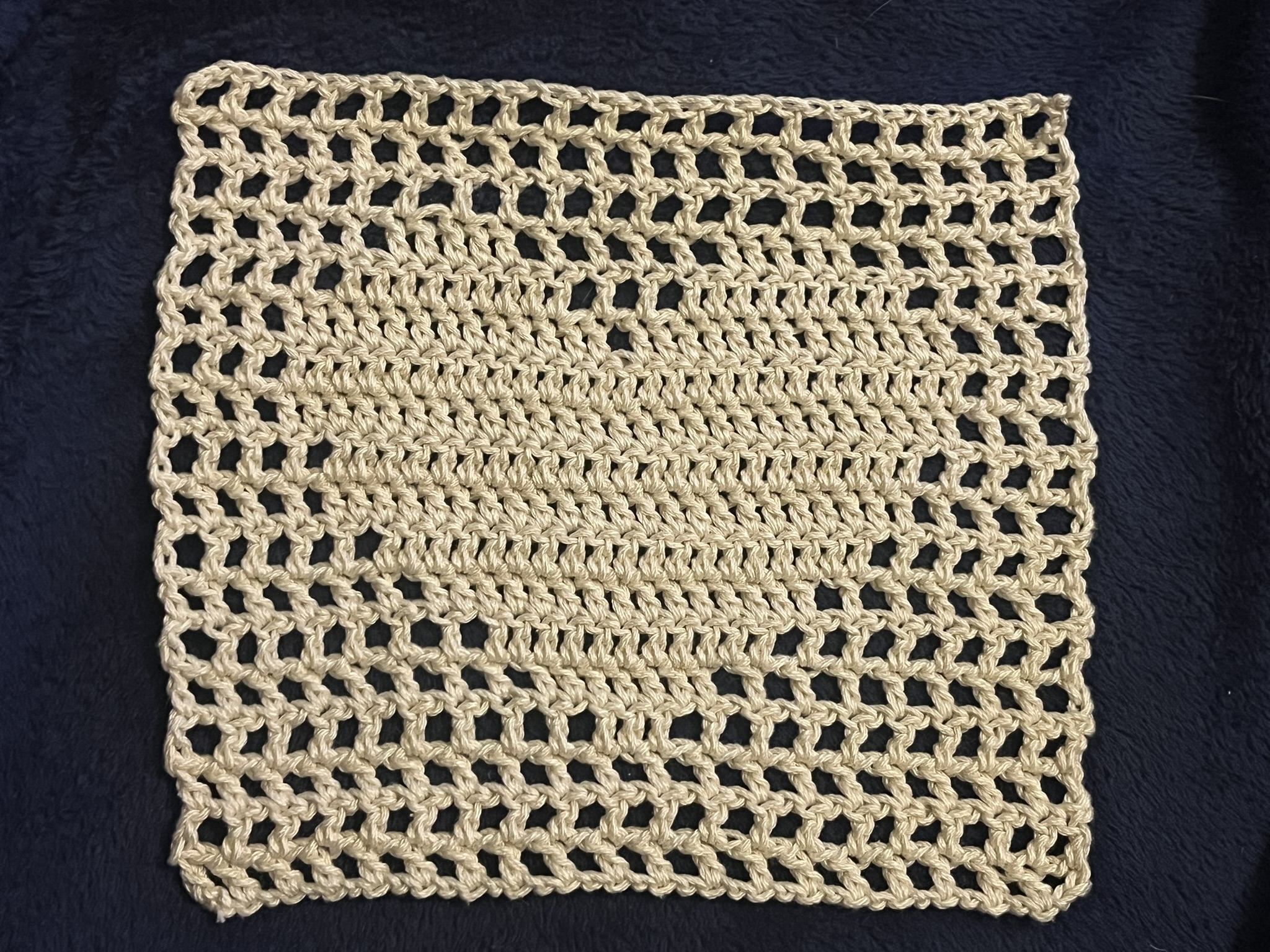
I read three tutorials on how to do filet crochet and I disagreed with all three. They all said that each "square" was supposed to be two stitches wide on the inside, and shared another stitch on each side with its adjacent squares. And I kind of get the idea of like, if it's a double crochet tall on each level then it should be two sitches wide but if you take into consideration the extra width from the border stitches then it makes the pixels look rectangular (i'll dig out my first attempt with their method to take a pic eventually so y'all can see the difference).
Anyways here's my method for filet crochet (as used in the pic above!!)
- Find the pattern you'll use:
Any black and white pixel art, preferrably simple if it's your first project like this! Here's the one for the heart piece shown above:
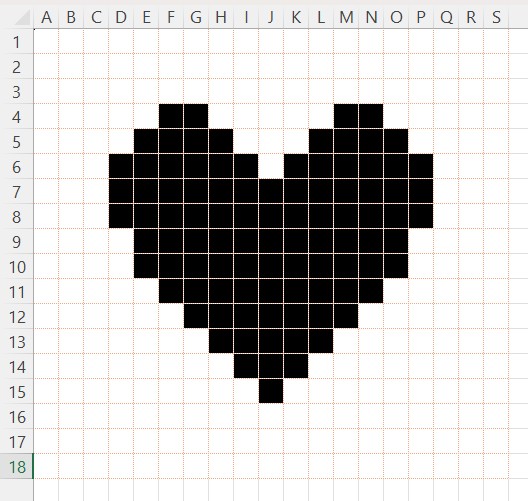
Count how many squares there are along the bottom of the piece (or side, depending on which direction of the project you wanna start in. I just tend to start at the bottom and build up.
- For the foundation, chain 2 x (number of squares on your starting side) - 1
So for the heart, which has 19 squares, we chain 2 x (19) - 1 = 37.
And actually we're about to chain more. So at this point, the chain is one pixel short of the amount we actually need. And we also need to make the first vertical movement into fully forming that first pixel, so we're gonna chain 4 more. So I guess actually the real foundation formula is 2 x (number of squares) + 3
- So to make our first pixel, we need to do a double crochet into the FIFTH loop from the hook (so the original stopping point I had mentioned, the one right before those final four!)
- For empty pixels, you'll chain one and then double crochet into the next next loop, so skip the first loop.
It's like the chain1 is the top of the pixel box, and the double crochet into the second loop is the left wall of the box, so the skipped loop is the empty center.
- For solid pixels, you'll double crochet into both of the next two loops.
So you're filling in that normally skipped loop.
- To move onto the next row, I take out the crochet hook, flip the piece around, and put it back in. Maybe it wouldn't matter if I kept it in while rotating but idk why I don't ¯\_(*v*)_/¯ And then chain 4, double crochet into the second loop, and keep going!! Well actually that's assuming that there's no solid pixels on your left or right edges... that's what was the case for my first project. idk about if you have a solid pixel then, maybe just jump straight into two double crochets?? i'll share if I ever try something like that.
Any black and white pixel art, preferrably simple if it's your first project like this! Here's the one for the heart piece shown above:
Count how many squares there are along the bottom of the piece (or side, depending on which direction of the project you wanna start in. I just tend to start at the bottom and build up.
So for the heart, which has 19 squares, we chain 2 x (19) - 1 = 37.
And actually we're about to chain more. So at this point, the chain is one pixel short of the amount we actually need. And we also need to make the first vertical movement into fully forming that first pixel, so we're gonna chain 4 more. So I guess actually the real foundation formula is 2 x (number of squares) + 3
It's like the chain1 is the top of the pixel box, and the double crochet into the second loop is the left wall of the box, so the skipped loop is the empty center.
So you're filling in that normally skipped loop.
Those three tutorials I read (btw no REAL pictures of an actual project on any of those three, just stock photos of filet crochet. ugh I hate the way that Search Engine Optimization and advertising has made the most easily-found informational websites into nothing but rushed, made-for-clicks and often AI generated passive income sources. bring back vintage websites!! bring back websites with heart and soul!!) still had a point with the concept of shared walls. So like each pixel is 2 stitches wide, but it's like it'll have its own singular stitch in the middle and then also "has" 0.5 stitches on both the left and right side (the other 0.5 stitches belong to the adjacent pixels since the walls are shared) for a total of 1 + 0.5 + 0.5 + 2. But this also means that you'll need to add one more stitch (on your working edge) than just 2 per pixel, to account for the solid border being on both sides (otherwise empty pixels on one side will open directly onto the edge of the project!) This doesn't really matter in terms of knowing the technique, I just think it's good to know if you're looking to make freehand projects.
my next project...